
News
Published 1 December 2025Indigenous scholars meet with leading academies to agree priorities

More than 130 Indigenous scholars and knowledge-holders from Aotearoa New Zealand, Canada, and Australia gathered this week to discuss challenges and opportunities for Indigenous-led research.
The Summit – the second arising from a Tri-Academy Partnership between Royal Society Te Apārangi, the Royal Society of Canada, and the Australian Academy of Science – was led by Indigenous Fellows of these three organisations.
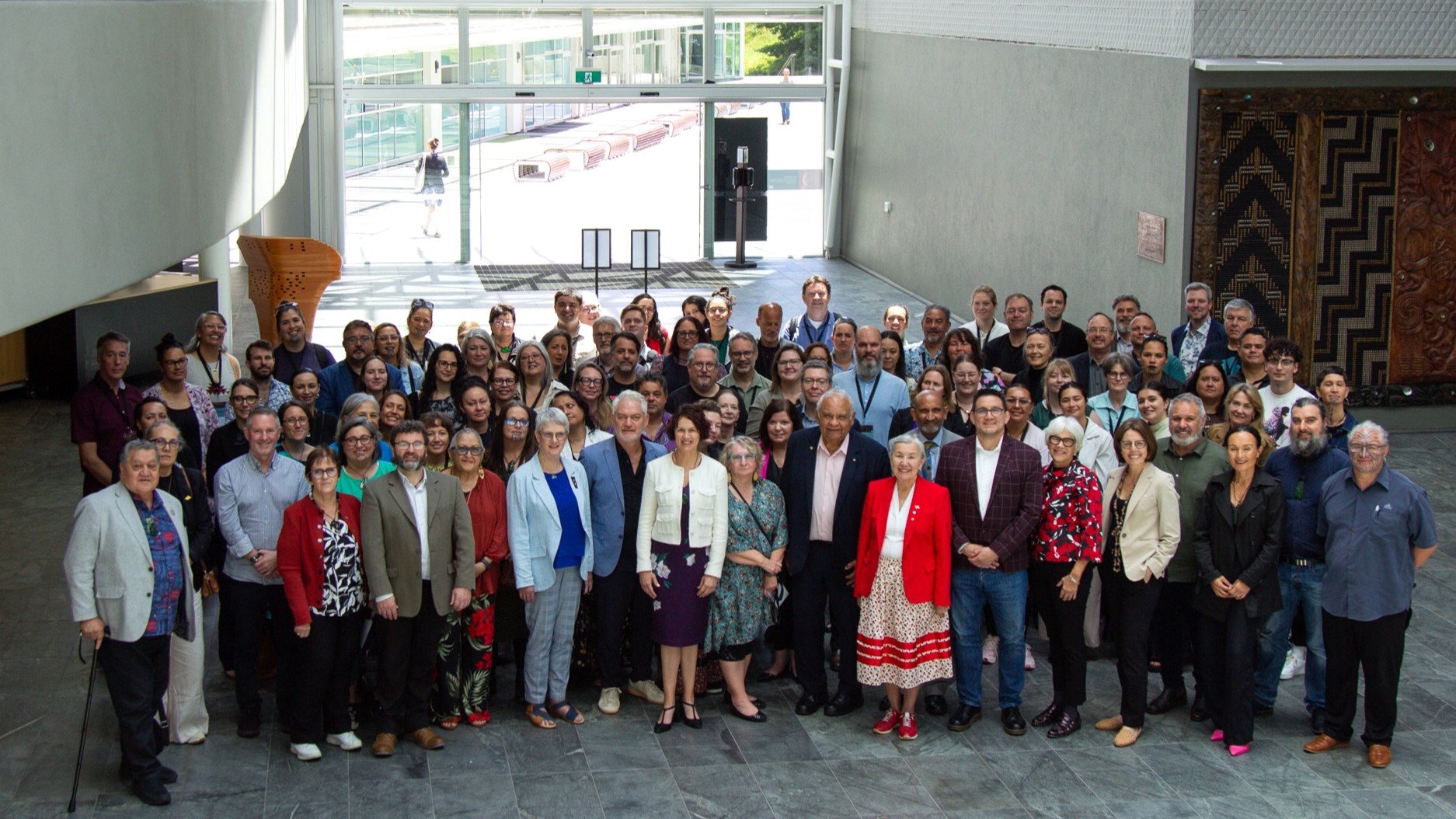
Attendees at Taikura summit
Over 3 days of keynote speeches, wānanga, cultural activities, and panel discussions, top Māori and Pasifika thought-leaders engaged with First Nations experts from Canada and Australia, including Fellows from five of Australia’s learned academies.
Key themes included the need to dismantle academic barriers and inequities for Indigenous students and researchers, share decision-making about research practices and priorities, and shape research agendas to focus on Indigenous knowledges and address challenges that are important to Indigenous Peoples.
Indigenous scholars and knowledge-holders talked about their experiences in academia, and presented research ranging from the study of Indigenous histories, cultures, knowledges, and languages to environmental management and traditional legal systems.
Indigenous scholars and knowledge-holders have championed and led education and research by, with, and for Indigenous communities, and have revitalised interest and awareness in traditional knowledges through language, cultural activities, and creative arts. Their work has explored and built on Indigenous knowledge systems to generate new insights and innovations – such as research methodologies and ethical frameworks based on traditional worldviews and values.
At the conclusion of the Summit, Indigenous leaders including Professor Tahu Kukutai FRSNZ, of Ngā Pae o te Māramatanga Centre of Research Excellence produced a Communique urging the academies produced a Communique urging the academies to support transformation of higher learning to dismantle structural inequities. They called for "a global research landscape that is inclusive, respectful, and transformative – one that recognises Indigenous Peoples as equal partners and leaders in the pursuit and application of knowledge."
The Presidents of Royal Society Te Apārangi, the Royal Society of Canada, and the Australian Academy of Science agreed with delegates on the need to redress research practices which have marginalised, misrepresented, and appropriated Indigenous knowledges. In a Statement , read by the President of the Royal Society Te Apārangi, Distinguished Professor Dame Jane Harding DNZM FRSNZ FRACP, they reaffirmed their commitment to working in partnership to help protect the rights they reaffirmed their commitment to working in partnership to help protect the rights and responsibilities of Indigenous Peoples to determine their own research agendas; to explore, preserve, and grow traditional knowledge systems; to participate actively in research; and to benefit from its applications and outcomes.
The next Summit of the Tri-Academy Partnership will be hosted by the Australian Academy of Science and its partners in 2026.
View Taikura documents:
- Communique from Indigenous research leaders
- Presidents' Statement in response to Communique
Taikura Summit programme:
View the programme for more information on the programme and the speakers.
- View Taikura programme as a digital flip book
- View Taikura programme as a PDF
- View Taikura programme schedule